Before You Begin
A Note to the English-Language Reader: This journey unfolded, and was originally written, in France. For this international edition, cultural references, kitchen terms, and everyday measurements have been thoughtfully adapted so that wherever you are reading, these pages speak directly to your daily life while remaining faithful to the lived experience at their heart.
I write under the pen name K.V. Serene. The names, places, occupations, and certain events from my family and professional life have been changed or blended to protect my privacy and that of the people I love. As such, parts of this narrative incorporate literary dramatization. Reconstructed dialogues are not word-for-word transcriptions.
My personal journey with psoriasis, the treatments I remember, and the changes I observed form the true core of this book. Approximate dates remain approximate. The personal photographs mentioned in these pages capture my skin at specific points in time; on their own, they cannot fully explain the shifts that took place between those milestones. They are not reproduced in this edition. The accompanying illustrations depict fictionalized scenes.
I am not a doctor. I share my own decisions, my mistakes, and my honest observations. The recipes and practical tools are meant to offer ideas to help organize daily life; they do not constitute a medical treatment for psoriasis. My personal experience cannot predict what your results will be. Neither this book nor the suggested meal plans have undergone clinical validation or review by healthcare professionals.
Before making any significant dietary changes, please consult the healthcare professional overseeing your care—particularly in cases of food allergies, underlying health conditions, pregnancy, or ongoing medical treatments. Any adaptations should always respect your individual nutritional needs. Most importantly, any modification to a prescribed medical treatment must be decided together with your healthcare provider.
Introduction — A Summer in Shorts
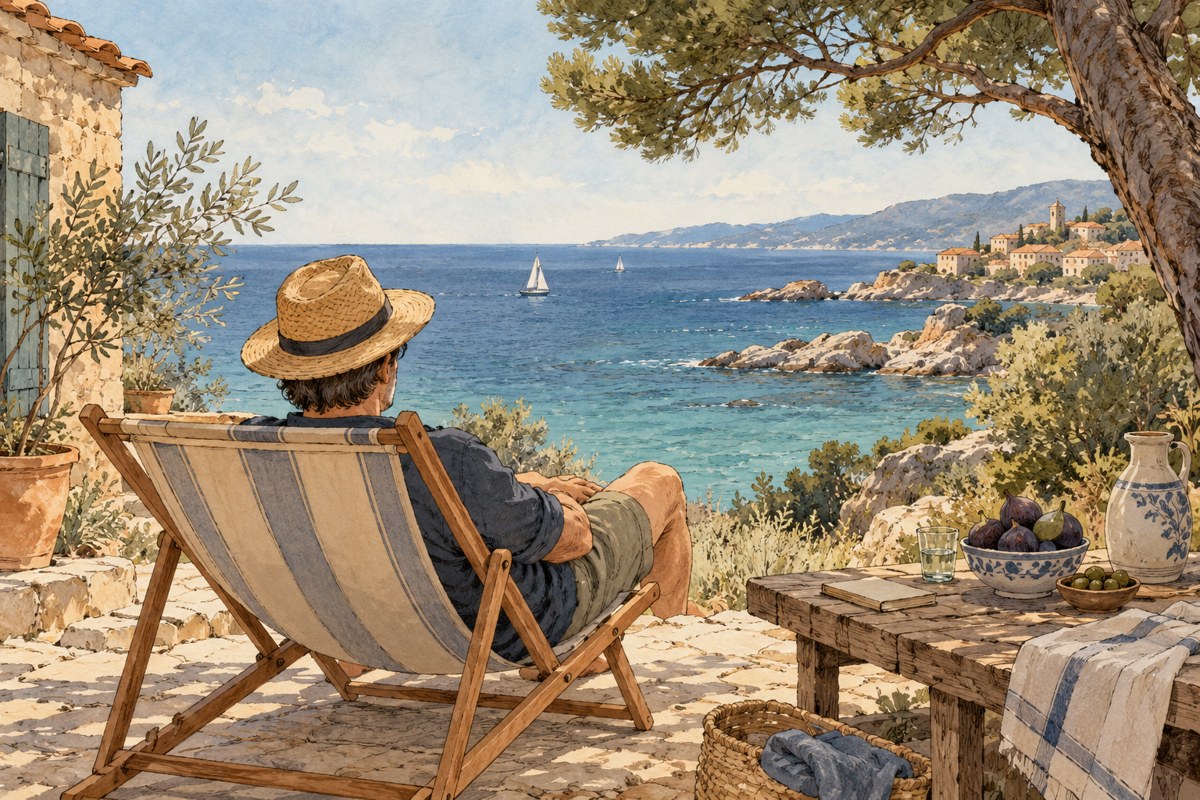
Illustration depicting a fictionalized scene.
In the summer of 2020, I took a trip to the seaside, and I put on a pair of shorts.
An ordinary sentence. You could find it tucked into almost anyone’s holiday journal. But for me, it carried immense weight.
Just the year before, both of my legs were covered in plaques. I had patches on my arms as well. At times, the itching took over everything. Summer heat and sweat made daily life even harder to bear. Working became deeply uncomfortable. Slipping into a pair of shorts was no longer something I could simply do without a second thought.
In a photograph from early 2019, you can see a large, red, scaling area spreading across my leg. In another, several thick patches take up part of the other leg. I keep those pictures because memory, on its own, tends to soften and blur the reality.
Then there is that photograph from the summer of 2020. I am sitting in a lounge chair, my legs bare to the sun. It doesn’t prove or measure anything clinically. What it does is capture a quiet, private moment in my life that means the world to me.
Between those two pictures lie countless meals, trial and error, unanswered questions, and late nights spent researching. There were doctor appointments, products I placed my trust in, advice that sounded completely convincing, and results I waited on with bated breath. And running alongside all of that, there were the ordinary hardships that don’t pause just because you are struggling with your skin: looking for work, paying rent, grocery shopping on a tight budget, and trying to stay present for the people around you.
I had begun searching for answers in the very early years. But by 2019, that search had turned into an obsession. I read voraciously, watched videos, and compared personal testimonials. One idea led to another. Every new avenue seemed to promise the missing piece of a puzzle I hadn’t yet solved.
The real challenge, however, came afterward—standing in the kitchen or holding a tube of cream: what do you actually do with all this information?
One person would recommend a product; another would warn you never to touch it. One testimonial showed remarkably clear skin, without explaining what else had changed in that person’s life at the exact same moment. A dietary chart would categorize foods with supreme confidence—a certainty I could never replicate in my own body. I had to choose, try, wait, and then wonder what the outcome really meant.
And through it all, the itching continued.
If you have ever spent an entire evening searching for answers for your skin, you probably recognize that deep exhaustion. You can read until your eyes ache and still feel completely lost when preparing the next meal. You can follow a routine with meticulous dedication and still have no idea how to explain it to the people sitting across from you at dinner.
This book was born from that very space.
In these pages, I will recount the first subtle warning sign, the medical consultations, the appeal of a product marketed as all-natural, my late-night searches, and the changes I ultimately made to my diet. I will also share what those changes actually required at home. A list of foods takes up very little space on a page. In family life, however, it takes over the refrigerator, the prep time, and the dinner-table conversations.
For a long time, I believed that all I needed was the right information to know what to do. Over time, I learned that practical execution mattered just as much: having ingredients ready to cook after an exhausting day, finding ways to share a family meal, and explaining your choices without sparking an argument.
The practical portion of this book is designed to support you through those exact moments. You will find meal ideas, a month of adaptable menus, straightforward substitutions, and a personal tracking journal. You can use these tools to suit your own needs, your palate, and the guidance established with the healthcare professional who oversees your care.
Along my journey, many things shifted at once: what I ate, my weight, daily habits, and my overall living conditions. While I noticed clear improvements alongside these changes, I cannot measure the exact contribution of each factor. Telling this story honestly, in all its detail, feels far more helpful than trying to reduce it to a single explanation.
Today, in October 2026, my diet is much broader and more relaxed than during its most rigid phase. I occasionally enjoy an ice cream or a sauce-free kebab. Every once in a while, I have a beer. These details belong to the life I lead as I write these words. They remind me that my journey is still ongoing, with habits that continue to evolve.
I recently took a new photo of my legs. Like the older ones, it captures a single moment in time. One day, I would like to show them all side by side, with their dates and context. In these pages, my focus is the story that unfolded between the pictures.
When I think back to that pair of shorts in the summer of 2020, what comes to mind most is just how much space my skin had taken over in my life. I wish I had had a book back then that spoke not just about treatments, but about grocery shopping, family dynamics, and the quiet questions we never quite manage to ask in a doctor’s consultation.
Here is that story.
It begins with a tiny mark on my leg. A mark I was certain would vanish on its own.
1. The Stubborn Little Mark
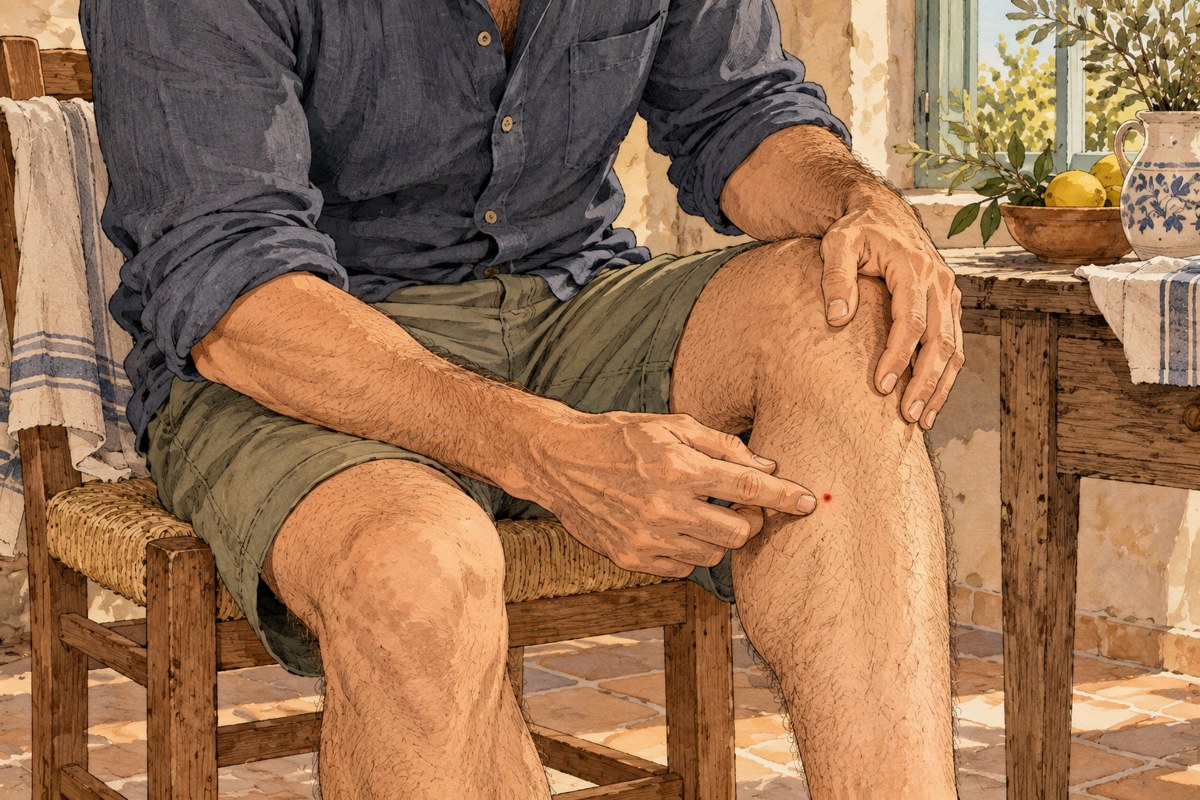
Illustration depicting a fictionalized scene.
In the beginning, there was only a small mark.
I place its appearance around 2011 or 2012. I can no longer name the exact month. On my leg, a small red bump appeared that looked like an ordinary blemish, without any pus. It itched slightly. It certainly didn’t look like the beginning of something that would accompany me for years to come.
I kept waiting for it to go away.
Some days it would itch. Other days, I didn’t feel a thing. That ebb and flow made me believe it would eventually resolve on its own. Whenever it wasn’t bothering me, it was so easy to put the question out of my mind.
Yet it stayed. In fact, it grew a little.
That opening phase lasted a long time: a year, perhaps longer, maybe nearly two. Looking back, I could make this beginning appear much tidier by assigning it a precise date and an orderly sequence of events. That would make for a cleaner narrative. But my memory is hazier than that, especially when it comes to all the time spent merely waiting.
The little mark itself, however, remained vividly etched in my memory.
I remember going to see a first dermatologist. The term he used, as best as I recall, was “neurodermatitis.” He prescribed hydrocortisone.
I applied the cream. As for the outcome, I remember that same lingering ambiguity: at times it seemed to help, at other times nothing really changed. I couldn’t tell you the concentration, the exact number of weeks I used it, or give a precise accounting of that period.
What I do know is that the mark never truly left my life.
It didn’t bother me enough to consume my everyday life. I continued to believe it would eventually clear. It is a strange kind of balance: something lingers, you notice it, and then you turn back to whatever you were doing. As long as the rest of your body seems peaceful, waiting can take up immense space without you ever viewing it as a conscious decision.
Then, I noticed small marks appearing elsewhere.
A few showed up on my arms and on my other leg. In my recollection, they had reddish centers with skin flaking slightly at the edges. They were small, but their presence fundamentally altered the way I looked at that first one.
It was no longer alone.
In 2013, I consulted another dermatologist. This time, the diagnosis given was psoriasis.
That word finally attached a name to what I was seeing. It didn’t solve all the questions that lay ahead. I finally knew what to call the problem, but I still had to make sense of the treatments, the flare-ups, and that persistent feeling of starting over from scratch.
The doctor prescribed another topical corticosteroid, stronger than the first, as I understood it. I don’t remember it clearly enough to name it here.
The small spots on my arms disappeared. It felt as though this product was having a more definite effect. On my leg, on the other hand, that first patch only grew larger. I am simply recounting what I saw during that period; I do not know what explains the differing response from one part of the body to another.
After that, other marks would come and go. There were only a few of them. The one on my leg remained a constant presence. To give a sense of its size in my memory, I often picture a one-euro coin—about the size of a quarter. Its edges were irregular. Of course, that was never an exact measurement taken with a ruler.
A coin: very little surface on a leg. Yet an eternity when weeks stretch into months.
I had already started reading about skin issues during those initial years. After the diagnosis, my searches had a much more precise keyword. I could look up “psoriasis,” read explanations, and discover personal accounts from people describing experiences I was beginning to recognize.
Above all, I wanted to know how to get rid of it.
Back then, I worked an office job. Nearby, there was a place I loved going to for lunch. I often ordered a dish made with red kidney beans. It was delicious, and on a busy workday, that was reason enough to choose it.
I began noticing that my patches seemed redder and itched more intensely after certain meals there.
At first, I told myself I was imagining things. An impression can feel convincing without being easy to prove. I was eating an entire dish made of many ingredients. My days were never completely identical. I kept no notes that would have allowed me to systematically compare one episode to another.
Yet, finding myself with that same impression time after time, I eventually began to take it seriously. In my memory, that dish with red kidney beans became firmly associated with the times my skin made its presence felt most intensely.
That memory remained an important turning point in my story. I cannot isolate a single culprit ingredient. What I can say is that I began looking at what I ate through a new lens: does this actually change anything for me?
That question would take on far greater weight a few years later.
At that stage, I had no method. I had a diagnosis, prescribed ointments, a stubborn mark, and a scattering of impressions that I didn’t yet know how to connect. The small patches that cleared gave me hope. The one that stayed drove me to keep searching.
Today, I can tell this opening chapter using the vocabulary I acquired later. Back then, I experienced things in a far simpler sequence: a mark, waiting, a doctor’s visit, a tube of cream, and then another mark.
What came next arrived via the internet.
Glowing testimonials. Before-and-after photographs. A product presented as all-natural.
In it, I saw a possibility that I desperately wanted to believe in.